
August 24, 2026
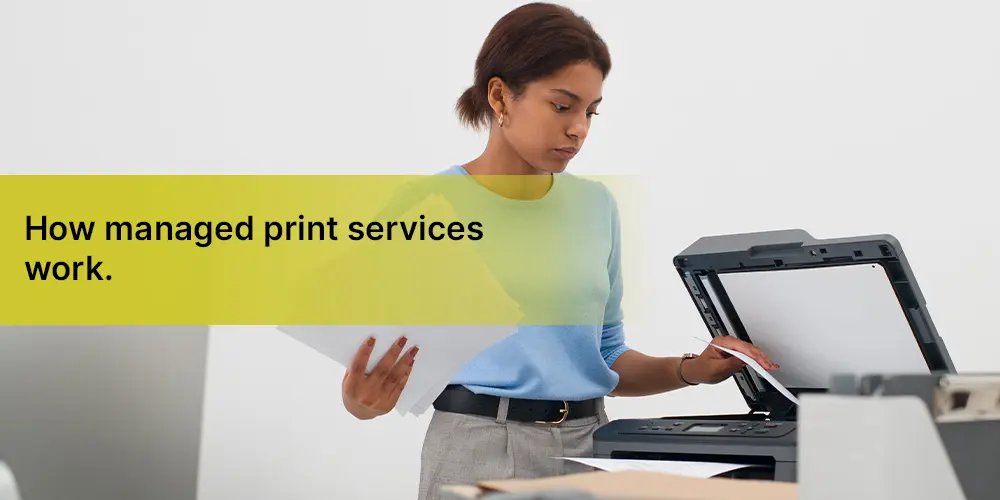
How Managed Print Services Work — And Why UAE Businesses Are Finally Paying Attention
Here's a number that might surprise you: the average office worker prints around 10,000 pages a year. Now multiply that across a mid-sized company in Dubai with 150 employees, factor in toner costs, machine downtime, IT hours spent troubleshooting printer errors, and the paper left abandoned in output trays — and you're looking at a print environment that's quietly draining tens of thousands of dirhams every year.
Most businesses don't notice because no one's really watching. Print costs are scattered across departments, hidden in supply budgets, and rarely tracked in any meaningful way. That's exactly the problem Managed Print Services (MPS) was built to solve.
So What Exactly Are Managed Print Services?
Managed Print Services is an arrangement where a third-party provider takes full responsibility for your organisation's printing environment. That means the hardware, the software, the supplies, the maintenance, and the strategy — all handled under one roof, usually through a fixed monthly contract.
Think of it like outsourcing your IT infrastructure, but specifically for everything that prints, copies, scans, or faxes. Instead of your team scrambling every time the copier jams or toner runs out at the worst possible moment, your MPS provider monitors your devices, sends supplies before they run out, dispatches engineers when needed, and gives you full visibility into what's being printed, by whom, and at what cost.
In the UAE, where businesses operate at a fast pace and office efficiency is tied directly to productivity, the appeal of this model is straightforward: less time managing printers means more time running your actual business.
How the Process Actually Works
Step 1: The Print Assessment
Every MPS engagement starts with an audit. Your provider will map out your entire print environment — how many devices you have, where they're located, how often they're used, what they cost to run, and where the inefficiencies are hiding.
This step alone often delivers eye-opening results. Companies in Abu Dhabi and Dubai regularly discover they have far more printers than they need, that 20% of their devices are responsible for 80% of their costs, or that certain departments are printing colour documents that could easily be black-and-white. The assessment becomes the baseline for everything that follows.
Step 2: The Optimisation Plan
Based on the audit, your provider designs a leaner, smarter print environment. This might mean consolidating 12 individual desktop printers into 4 high-performance multifunction devices. It might mean repositioning devices to reduce unnecessary walking time. It might mean implementing print policies that prevent colour printing for internal documents or require a PIN code before a job is released — reducing the reams of forgotten pages that pile up uncollected.
In a region where sustainability is increasingly tied to corporate reputation and regulatory expectation, this rationalisation also helps UAE businesses hit their environmental targets. Fewer devices, less energy, less paper waste.
Step 3: Ongoing Management and Monitoring
Once the optimised environment is in place, the MPS provider takes over the day-to-day. Remote monitoring software keeps an eye on every connected device in real time — tracking toner levels, usage volumes, error codes, and device health. When a printer needs attention, the system flags it before it becomes a problem.
Toner cartridges arrive at your door before you run out. Engineers are dispatched before a fault becomes a breakdown. You don't log a call, you don't wait on hold, and your team doesn't spend 45 minutes trying to fix a paper jam while a client presentation waits.
Step 4: Reporting and Continuous Improvement
Good MPS providers don't just manage — they analyse. Monthly or quarterly reports show you exactly how your print environment is performing: costs per page, volume trends, device utilisation, and department-level breakdowns. Over time, this data allows for continuous refinement. If one department's usage spikes, there's a conversation about why. If a newer, more cost-efficient device has entered the market, your provider will flag it.
For UAE businesses that answer to regional headquarters or international boards, this level of reporting also makes print costs easy to account for — no more vague line items buried in operating expenses.
The Business Case for UAE Companies
The UAE market has some specific characteristics that make MPS particularly relevant right now.
Rapid business growth creates print complexity. Companies scaling quickly across the Emirates often accumulate devices reactively — buying a printer here, leasing a copier there — with no overarching strategy. MPS brings structure to environments that have outgrown their original setup.
A multilingual, document-heavy business culture. From legal contracts in Arabic and English to trade documentation, compliance certificates, and HR paperwork, UAE businesses tend to be document-intensive. Managing that volume without a system in place leads to ballooning costs and inconsistent quality.
The shift toward Smart Office infrastructure. Dubai's Smart City ambitions and the broader push toward digital transformation across the Emirates have made businesses more receptive to technology-driven solutions. MPS fits naturally into a modernised office stack — integrating with cloud systems, secure networks, and mobile printing capabilities that a distributed workforce actually needs.
VAT and cost transparency. Since the introduction of VAT in the UAE, finance teams have been under pressure to categorise and justify operational spend more precisely. A fixed monthly MPS fee is far easier to account for than unpredictable toner purchases, ad-hoc maintenance calls, and departmental supply budgets that no one quite owns.
Common Concerns — Addressed Honestly
"We'll lose control of our printing." The opposite is true. MPS gives you more control than you've ever had — data on who's printing what, the ability to set rules and restrictions, and a provider accountable to SLA terms. Most businesses discover they had very little visibility before MPS.
"It's only worth it for large enterprises." Not anymore. MPS solutions in the UAE now scale down comfortably to SMEs with as few as 10 to 15 devices. If you're spending unpredictably on print today, the model makes financial sense at almost any size.
"What about data security?" This is a fair concern, especially for businesses in legal, financial, or healthcare sectors. Reputable MPS providers build security into the solution — encrypted print jobs, pull-printing that requires user authentication, and audit trails that meet local and international compliance standards. In many cases, MPS actually strengthens print security rather than weakening it.
Conclusion
Managed Print Services won't transform your business overnight. But for any UAE company spending time, money, and energy managing a print environment that was never really designed — it removes a persistent operational headache and replaces it with something reliable, measurable, and cost-controlled.
The businesses that have made the shift tend to say the same thing: they wish they'd done it sooner. Not because printing suddenly became exciting, but because it stopped being a problem.
And in a market as competitive and fast-moving as the UAE's, fewer problems is always a good place to start.